

Architecture—one of the few cultural artifacts made to be publicly lived with, preserved, and often capable of standing for centuries—contributes significantly to the cultural identity of places and people. Historically, buildings have expressed institutional attitudes, influence, and power; they are clear demonstrations of culture. Yet longevity complicates preservation: when a structure is rebuilt, repaired, or entirely reassembled, in what sense is it still the same building?
There's the classic Ship of Theseus puzzle from Plutarch. if a ship's planks are replaced one by one over time, is it still the same ship? Thomas Hobbes adds a twist—if the original planks are reassembled elsewhere, which ship is "the original"? The paradox tests what grounds identity: material fabric, continuous use and history, or shared recognition. In architecture and conservation, it reframes preservation as a choice among keeping matter, maintaining form and function, or sustaining the stories and practices that give a place meaning.


Approaches differ across traditions. In many Western contexts, authenticity is often tied to surviving material—replacements can be seen as a loss of originality. By contrast, in parts of the East, longstanding practices encourage periodic rebuilding in the same form and technique, so that the act of making and the process of architecture—and the craft, ritual, and typology it sustains—becomes the vehicle of cultural memory. Examining these positions reveals how architecture can preserve heritage through design and construction processes, and at times through the deliberate act of rebuilding.
Related Article
The Eternal Ephemeral Architecture of Shikinen Sengu: The Japanese Temple Rebuilt Every 20 YearsEver-Fresh Permanence: Ise Jingu's Ritual of Renewal

Consider Ise Jingu in Mie, Japan, the Shinto complex dedicated to Amaterasu Ōmikami and Toyouke-hime. Visitors often come for its serene composition of cypress timber and thatched roofs, yet the shrine's most distinctive attribute is not a fixed architectural object but a living architectural procedure. Every twenty years the principal sanctuaries are dismantled and rebuilt on twin, adjacent plots to meticulous specifications. The practice—Shikinen Sengu—treats construction and architecture itself as cultural heritage: craft knowledge, forest stewardship, and ritual choreography are renewed in tandem with the buildings.
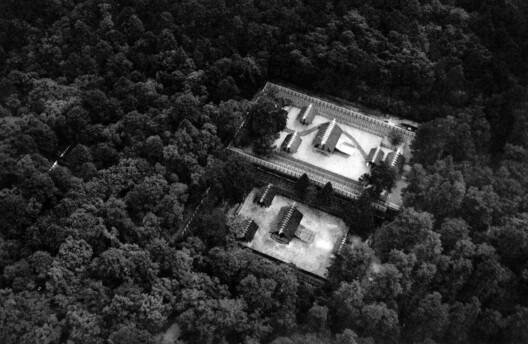
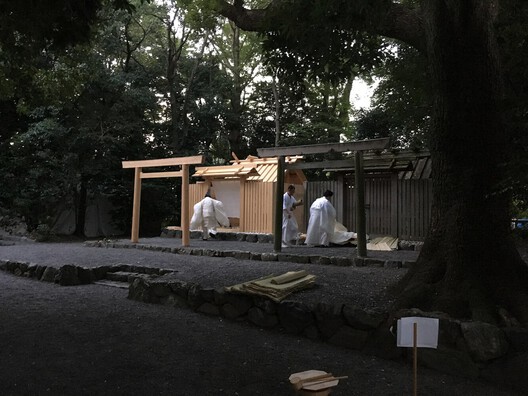
This cyclical rebuilding is grounded in the concept of tokowaka, the idea of "ever-fresh permanence": to remain new without abandoning form. Rather than preserving material fabric at all costs, Ise preserves pattern, proportion, joinery, and ceremony. The result is a paradox with clear intention—structures are simultaneously ancient and young, original and renewed. The current iteration, completed in 2013, is the sixty-second; the next is scheduled for 2033. Each cycle extends far beyond the main halls: roughly 170 related structures—from auxiliary shrines to torii—are reconstructed, preceded by an eight-year period of preparation punctuated by more than thirty rites.

Seen this way, Ise reframes the Ship of Theseus problem. Identity here is not anchored in unchanging material but in continuous architectural making—an unbroken lineage of technique, forestry, liturgy, and public recognition. The shrine's authority lies in this chain of transmission: carpenters train successors; sacred timber is cultivated and harvested; rituals mark each threshold of the work. Architectural endurance is achieved by renewing matter so the immaterial—meaning, craft, and devotion—remains legible.
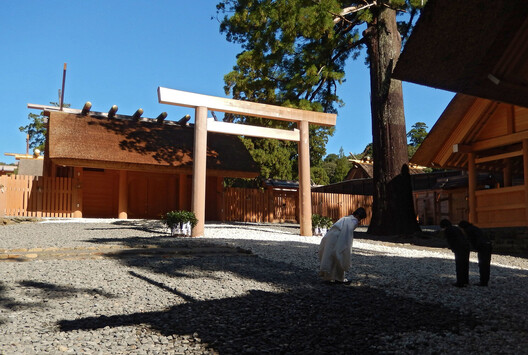
The logic is not as esoteric as it sounds. It mirrors cycles visible in everyday life: cherry blossoms that return each spring, rice fields that are harvested and replanted, festivals that rehearse community memory through repetition and variation. Ise gives that seasonal rhythm architectural form—changing in order to remain unchanged—and in doing so proposes a model of preservation in which buildings survive not by resisting time, but by moving with it through a rigorous process of rebuilding.
Bamboo, Community, Repeat: Hong Kong's Living Heritage
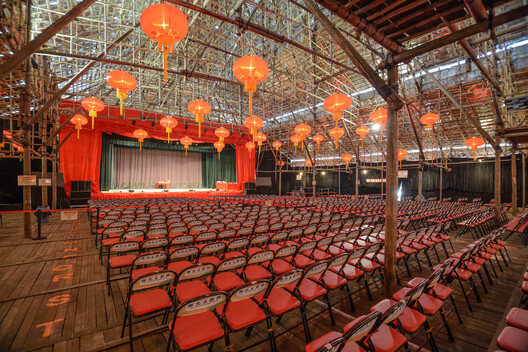
Elsewhere in Asia, in Hong Kong, preservation through rebuilding takes a lighter, more community-led form. While the city lacks an institutional process as formal and exacting as Ise's, it sustains equally compelling—if more temporary—structures that are erected, dismantled, and re-erected on an annual cycle. Chief among these are the city's bamboo theatres and festival structures. In the past, during celebrations of Tin Hau (goddess of the sea) in fishing villages, bamboo theatres appeared across neighbourhoods each year, then vanished, only to return the next season. Unlike Ise's codified rituals, these theatres embody a looser ethic of continuity: their preservation resides less in strict replication than in shared practice, local craft, and communal labor. Built largely by small ensembles and residents' associations, the recurring act of construction keeps alive both as a repertoire of performance and as a distinctive knowledge of bamboo scaffolding.


Other festivities renew culture through the same cyclical making. During the Mid-Autumn Festival, Tai Hang's Fire Dragon Dance animates the streets with a serpentine figure approximately 220 feet long, formed from rattan frames, straw, and rope, and studded with some 12,000 burning incense sticks. Each year the dragon and the performance backstage is reconstructed from scratch, and the backstage choreography—soaking, binding, threading, and lighting—becomes as integral to the tradition as the parade itself. Rather than safeguarding a single, enduring artifact, Hong Kong's festival architectures conserve memory through repetition and re-making. The bamboo theatres and the Fire Dragon together show how space-making, when renewed year after year, can embed itself in civic life—an architecture of practice that shapes cultural memory as surely as any permanent monument.


Reassembly as Heritage: Interiors, Monuments, and Urban Lines
Other cases show how a reconstructed artifact can still carry a community's cultural memory. Consider Osaka Castle, a palimpsest of rebuilding in Japan. First completed in 1597, it has been dismantled, destroyed, and rebuilt multiple times—whether by siege, lightning, or war. The Tokugawa rebuilt after the early 17th-century conflicts; the keep later burned and was re-erected; the 20th century brought another major reconstruction, followed by extensive restoration in 1997. What visitors encounter today is not a single, continuous fabric but a carefully renewed ensemble that carries forward the castle's form, urban role, and narrative. Here, continuity is secured less by uninterrupted material than by reiterated silhouette, craft knowledge, and public recognition—a rebuilt structure anchored in civic memory.


China's Yongdingmen Gate in Beijing offers a parallel lesson. Originally erected in 1553 as the southern gate of the Outer City, it was demolished in the 1950s amid transport modernisation. Its subsequent rebuilding on the original site—completed in the mid-2000s—was part of a broader effort to realign and reaffirm the city's north–south ceremonial axis. The new structure is explicit about its status: a reconstruction that restores the gate's spatial signal and ritual function. As with Osaka, the project preserves urban meaning by reinstating a form and position that organise collective memory, even though the masonry itself is new.


At the scale of interiors, Hong Kong's M+ Museum demonstrates how museums can conserve architecture through disassembly and reassembly. The relocation and restoration of Kuramata Shiro's Kiyotomo sushi bar treats a complete interior as an artifact—catalogued, transported, and reinstalled so that proportion, detail, and atmosphere survive beyond the lifespan of the original premises. The result is neither mere décor nor a replica; it is a case study in how design authorship and material exactitude can be preserved by moving the work into a new custodial frame. Hong Kong's Stanley Murray House extends the logic to a full building: dismantled from Central and re-erected in Stanley, it keeps the tectonic grammar and spatial order while trading one urban narrative for another. Its value now turns on how programming, interpretation, and everyday use reconnect the transposed fabric to living culture.

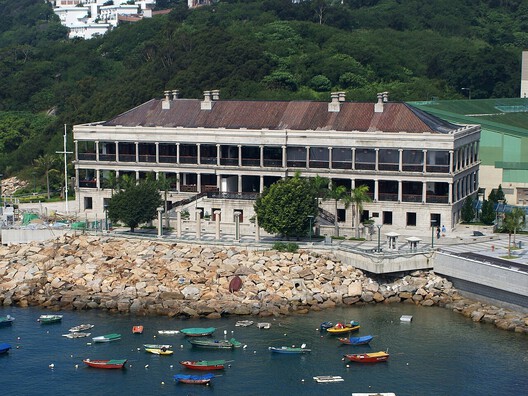
Taken together, these examples suggest a spectrum of cultural memory through rebuilding—from castles and gates that reassert urban identity, to interiors conserved as complete works, to whole buildings transposed and recontextualized. Each answers the Ship of Theseus in a different key: sometimes by renewing form to stabilize meaning, sometimes by carrying craft and detail forward intact, and sometimes by pairing reconstruction with new forms of public engagement so that the rebuilt architecture continues to accrue cultural memory in the present.
This article is part of the ArchDaily Topics: The Architecture of Culture Today. Every month we explore a topic in-depth through articles, interviews, news, and architecture projects. We invite you to learn more about our ArchDaily Topics. And, as always, at ArchDaily we welcome the contributions of our readers; if you want to submit an article or project, contact us.


